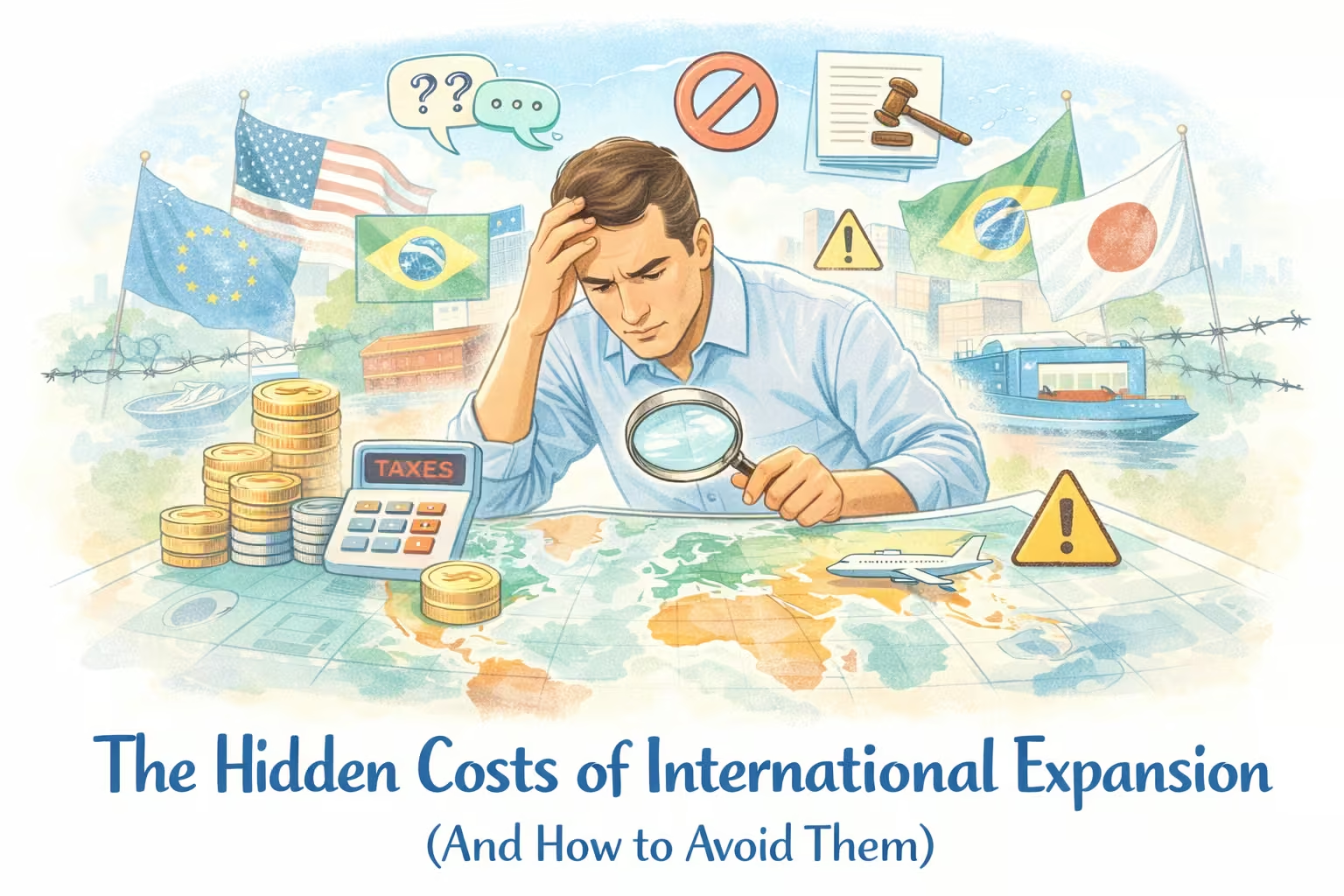

Balancing Risk and Reward: How Entrepreneurs Make Tough Decisions
How Entrepreneurs Make Tough Decisions
Entrepreneurship is often described as a journey into the unknown. Every major step—launching a new product, entering a new market, or investing limited capital—carries uncertainty. For entrepreneurs, the challenge is not avoiding risk entirely but balancing risk with opportunity.
Successful entrepreneurs rarely take reckless chances. Instead, they focus on calculated risk-taking. Before making a decision, they often consider key questions: What is the potential reward if this works? What is the worst-case scenario if it fails? And most importantly, can the business recover from that outcome? By evaluating both the upside and the downside, entrepreneurs turn uncertainty into something manageable.
One common strategy is testing ideas through small experiments. Rather than committing large resources immediately, founders often start with limited trials—such as launching a minimum viable product, testing a marketing strategy with a small audience, or running a short pilot program. These experiments allow entrepreneurs to gather feedback quickly while keeping potential losses low. If the idea proves successful, it can be scaled; if not, it can be adjusted or abandoned.
While data plays an important role in modern business decisions, entrepreneurs frequently operate in situations where information is incomplete. In these moments, experience and intuition often guide decision-making. Many founders rely on insights gained from previous successes and failures, combining available data with personal judgment to identify promising opportunities.
Another key factor is the ability to recognize high-impact opportunities—situations where the potential reward outweighs the risks involved. Entrepreneurs are constantly searching for ideas that could significantly change the direction of their business. Even if the probability of success is uncertain, the potential payoff may justify the risk.
However, balancing risk and reward is not only a strategic exercise; it also requires emotional resilience. Entrepreneurs regularly face setbacks, unexpected obstacles, and difficult choices. Those who succeed learn to accept failure as part of the process, adapt quickly, and maintain confidence despite uncertainty.
In the end, entrepreneurial success rarely depends on a single bold move. Instead, it is built through a series of thoughtful decisions, where risks are carefully weighed against potential rewards. By combining analysis, experimentation, intuition, and resilience, entrepreneurs transform uncertainty into opportunity—and turn challenging decisions into pathways for growth.